FPL Team Analyzer
Get a fast, decision-ready breakdown of your exact FPL squad. Paste your Team ID and FPLai scores your 15-man squad, flags weak spots, ranks your best transfer moves by expected gain, and highlights the captaincy call that matters most before the next deadline. It is built for managers who want clear actions, not another dashboard full of raw numbers.

Start with the team rating, then act on the transfer order
The analyzer turns your Team ID into a squad-specific report: team score, transfer priorities, captain call, risk flags, and next action in one weekly workflow.
How the AI Analysis Works
The analyzer pulls your live squad from the official FPL API, checks every player against current form, fixture difficulty, price trends, availability, expected minutes, and ownership context, then ranks the moves most likely to improve your team.
Instead of showing the same player ticker to everyone, FPLai evaluates your exact structure: where you are overinvested, where you are carrying dead money, which positions are blocking upgrades, and whether a hit is actually justified. The output is a practical priority list you can act on before the deadline.
What You Get In Your Report
The best moves in and out, ordered by expected impact rather than hype.
A clear captain call backed by form, fixture quality, and upside.
A quick read on whether your team is in good shape or carrying avoidable weaknesses.
Rotation concerns, injury issues, bench problems, and price-drop exposure.
See What The Report Actually Shows

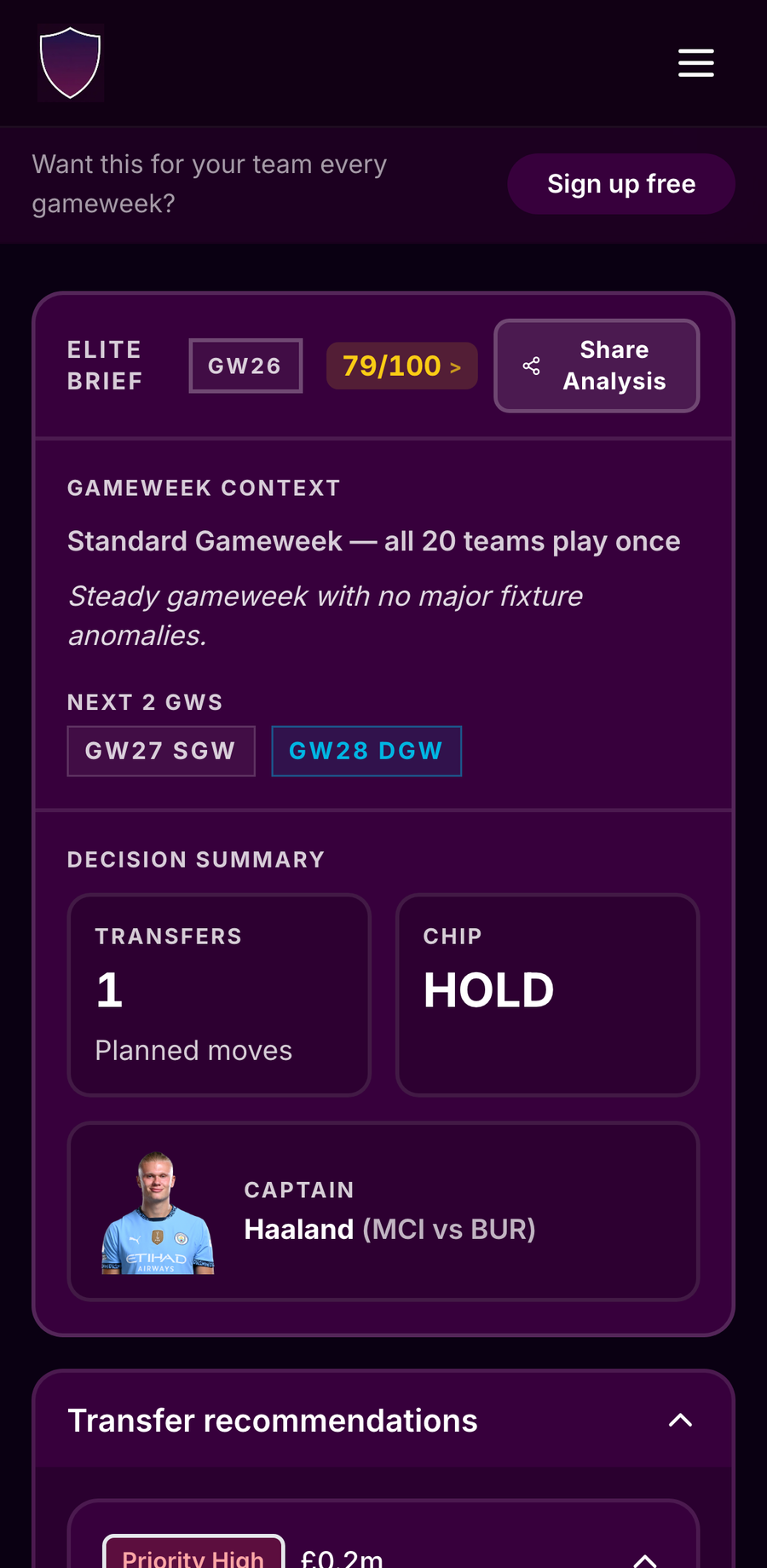
Priority-ranked transfer
The report starts with the move that matters most now, so you are not guessing which transfer deserves attention first.
Captain call with context
Captaincy is shown next to the decision summary, which makes the recommendation easier to trust and act on.
A weekly workflow, not a dead-end screen
This is a real FPLai result capture. The goal is to move you from one clear recommendation into the next decision before deadline.
Why Managers Trust This Analysis
FPLai is not a generic chatbot wrapped around football opinions. The analyzer is built around live Fantasy Premier League data, a repeatable scoring framework, and your actual squad context. That means the output is grounded in the same inputs every time rather than changing with the wording of a prompt.
- Live FPL data — Prices, flags, fixtures, minutes, and ownership signals are pulled from the official FPL feed
- Squad-specific context — The report evaluates your exact 15 players, budget structure, and transfer flexibility
- Clear reasoning — Recommendations are organised by practical impact, so you can see what matters now and what can wait
- Built for repeat use — The page works as a weekly decision tool before every deadline, not as a one-off novelty report
For managers who want the underlying framework, the FPLai methodology page explains the live inputs, weighting logic, refresh cadence, and decision constraints behind the report. For the strategic side of using AI without flattening your squad into the same template, read FPLai vs Template Team.
What Makes The Report Credible
The analyzer earns trust by combining live inputs with constraints that actually matter in FPL. It does not just rank players in the abstract. It scores moves inside your current team structure, which is why the recommendations are more useful than generic watchlists.
Official FPL prices, fixtures, player flags, ownership, recent output, and team context. The report is refreshed against the live game state rather than a static preseason model.
Transfer upside, captaincy value, squad weakness, price risk, and short-term planning are weighted into a recommendation order you can use before the deadline.
The output is built for one job: help you decide what to do next. That means clearer priorities, less overthinking, and fewer sideways transfers before the deadline.
Why Managers Use It Before Every Deadline
Most FPL decisions fail because managers either overreact to one haul or get stuck comparing too many options. The analyzer compresses that work into one report: what to fix first, what can wait, and which move gives you the biggest edge for the next gameweek.
That makes it useful for both ends of the market. Casual managers save time and avoid panic transfers. Competitive managers get a faster way to pressure-test their own thinking before locking in a move.
Works Worldwide
Fantasy Premier League (FPL) — known to some as fantasy soccer — is played by over 11 million managers around the globe. FPLai works whether you're in London, New York, Sydney, or anywhere else. All you need is your FPL Team ID, which you can find on the official FPL website or app.
What the AI Analyzes in Your Squad
FPLai's analysis engine evaluates six core data signals for every player in your 15-man squad, then synthesises them into a single recommendation layer:
- Recent Form (last 4 GWs) — Points per game weighted towards the most recent fixtures. A player averaging 8 points over 4 weeks is a stronger hold than one who scored 32 in a single haul.
- Fixture Difficulty Rating (FDR) — The official FDR scale (1-5) for the next 6 gameweeks, adjusted by home/away advantage and each team's defensive/attacking record against that rating band.
- Expected Goals & Assists (xG/xA) — Underlying stats from Opta that measure chance quality. A striker with high xG but low actual goals is likely due a scoring run — the AI flags these opportunities.
- Ownership & Effective Ownership — How many managers (overall and in the top 10K) own each player, and how often they're captained. This matters for rank movement: differentials create swings, template players protect.
- Price Trajectory — Predicted price changes based on transfer activity. The AI warns you before a player you own drops in price, protecting your squad value.
- Minutes Probability — Rotation risk based on minutes played, manager quotes, and competition schedule (Champions League, FA Cup). A player who's rested every third game is a bench risk you need to plan for.
Each signal is weighted based on its predictive power for FPL points — form and fixtures carry the heaviest weight, while ownership acts as a tiebreaker. The result is a recommendation score for every possible transfer, ranked from highest to lowest expected point gain.
FPLai vs Other FPL Analyzers
Most FPL tools are strong in one lane only. They either give you raw stats, generic content, or a spreadsheet-style planner. The gap is turning those inputs into a clear recommendation for your exact team. That is the lane FPLai is built to own.
| What you need before deadline | FPLai | Stat dashboards | Content-only tips | Manual spreadsheets |
|---|---|---|---|---|
| Squad-specific transfer order | ✓ | Partial | ✗ | Manual |
| Captain recommendation with context | ✓ | Partial | Partial | Manual |
| Live price, flags, and form signals | ✓ | ✓ | Partial | Manual |
| One place to move from analysis into next tools | ✓ | ✗ | ✗ | ✗ |
| Fast weekly workflow on web and iOS | ✓ | Partial | ✗ | ✗ |
| Free starting point | ✓ | Varies | Varies | ✓ |
The point is not that every other tool is bad. It is that most of them still leave you to connect the dots yourself. FPLai is stronger when the question is simple: what should I do with my team right now?
Use This Page As Your Weekly Control Centre
If you are comparing tools, this page is the simplest place to start. Run your squad through the analyzer, sanity-check the captain call, then use the linked tools for the next layer of decisions: buy and sell signals, captain matrix, differentials, promoted-team scouting, and wildcard planning.
It is meant to feel like a clean starting point, not a maze of widgets. Get the answer that matters first, then go deeper only if you need to.
When to Run Your Analysis
Timing your analysis can be just as important as the analysis itself. Here's the optimal schedule for maximum FPL advantage:
- After the last match of a gameweek — Run analysis once all fixtures are complete. This gives you the freshest form data and lets you plan your transfers with the full picture.
- Tuesday evening (UK time) — Press conference day. Managers reveal injury updates and rotation hints. Run your analysis after press conferences to incorporate the latest team news.
- 24 hours before the deadline — Price changes accelerate in the final 24 hours. Run a final analysis to check if any of your targets have risen in price or if any of your players are flagged for drops.
- Before activating chips — Always run a full analysis before playing your Wildcard, Free Hit, Bench Boost, or Triple Captain. Chip decisions are high-impact and deserve the most current data.
Avoid running analysis immediately after a single match — player data is noisy on a match-by-match basis. Wait for the full gameweek to complete for the most reliable recommendations.
Pro tip: bookmark FPLai and set a recurring calendar reminder for Tuesday evenings and Friday mornings. Consistent analysis beats reactive panic-checking every time.
FPLai vs other FPL tools
Most managers already use some combination of stats dashboards, content-only tips, manual spreadsheets, and screenshot-upload tools. Those can all help, but they often leave one gap: turning the evidence into a squad-specific next action.
Useful for research, but you still have to translate tables into your own team structure.
Good for ideas, but usually written for everyone rather than your exact 15 players.
Powerful if you maintain them, slower when prices, flags, ownership, and fixtures move.
Convenient for a quick check, but less reliable than reading the live squad from a Team ID.
FPLai is built around the weekly conversion moment: Rate My FPL Team, understand the score, then move into transfer, captaincy, fixture, or wildcard action.
Current Form Leaders — GW5
Updated for the 2026/27 season. Data refreshed each gameweek.
 Groß
Groß BHA
BHA Schade
 BRE
BRE Tarkowski
 EVE
EVE Kostoulas
 Bogle
Bogle LEE
LEEFrequently Asked Questions
Is the FPL team analyzer free?
How do I find my FPL Team ID?
How often is the analysis updated?
Can I use the FPL analyzer from the United States?
What time is the FPL deadline in EST?
Is there an FPL analyzer that works with the official app?
How accurate is AI FPL analysis?
Can I analyze someone else's FPL team?
What data does the FPL analyzer use?
Analyze My Team
Signed-in managers go straight into analysis. New users can create an account and continue into the same flow.
Analyze My Team